
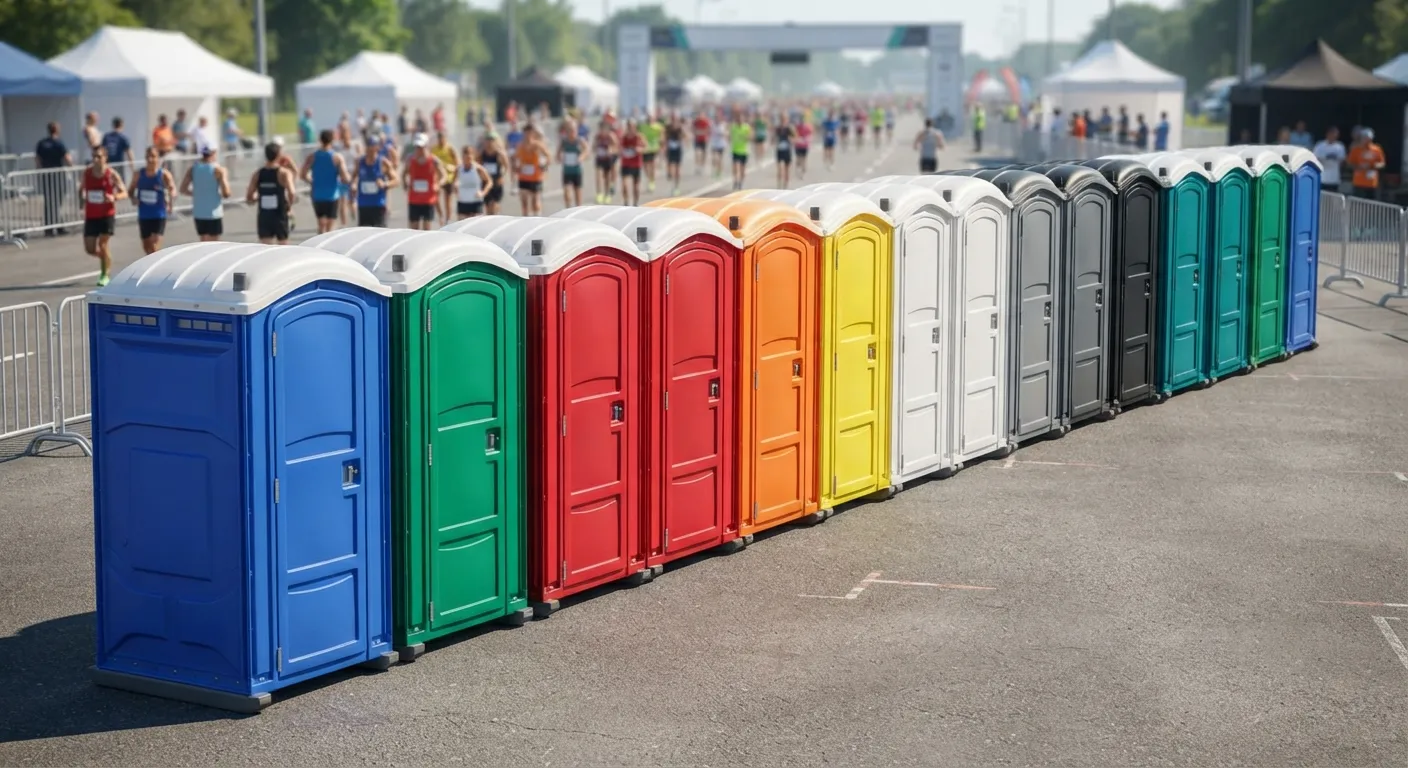
How many restrooms does a race actually need?
Start with the crowd curve, not the runner count alone. A marathon start line sees everyone at once for 20 minutes, then empties out, so that spot needs more units than a mid-course aid station where runners trickle through all morning. Glendale Porta Pros builds race plans around three zones: start, aid stations, and finish, sizing each separately instead of dividing one number by total headcount. For general staffing math beyond racing, our how many porta potties do I need guide walks through the ratios, and OSHA 1926.51(c) sets the baseline most planners still reference even for events: one toilet for 20 people, scaling up from there. Spectators change the math too. A start/finish area with a few thousand spectators needs its own cluster, separate from runner units, because spectators queue differently than athletes moving through in waves. Add at least one ADA accessible porta potty per cluster; ADA Standards 213.2 requires 5 percent of clustered single-user units to be accessible, never fewer than one, so a start line with eight units needs at least one ADA unit and a finish line with three still needs one. Standard units run in the standard porta potty rental day rate band, but race organizers typically book the event rate instead, which covers setup, servicing, and teardown as one line rather than a daily rental.
Where should units go on a race course?
Aid stations need units set back from the running lane, on stable, level ground, with truck access for servicing before the gun and again mid-race if the event runs long. Our porta potty placement guide covers ground conditions and clearance in more depth, but for races the short version is: keep units off the course tape, keep the queue line out of the runner lane, and leave the delivery truck a straight shot in and out. A standard unit sits about 44 by 48 inches on the ground and stands roughly 92 inches tall, small enough to tuck behind a water station tent without blocking sightlines for course marshals. If the race also needs event lighting near a start line staged before sunrise, that ties into light tower rental, and if timing equipment or announcer gear needs power at the finish line, ask about a temporary power pole - how to brace a temporary power pole matters here, since race day wind and foot traffic near a finish chute can knock over a poorly anchored pole, so it needs a stable base plate and guy points set before crowds arrive, not adjusted after. For races that also need crowd lanes at the finish, crowd control barrier rental and temporary fence rental handle chute separation. Races staged near Glendale often coordinate multi-city logistics too; Sun City sits 9.1 miles northwest and Youngtown 9.6 miles northwest, both close enough that a single delivery route can serve a point-to-point course crossing city lines.

What does race-day restroom service cost?
Pricing depends on unit count, event length, and whether the race needs a dedicated servicing pass mid-event. Most single-day races book at the event rate below rather than a straight daily rate, since it bundles delivery, pickup, and any on-course servicing into one number.
| unit | duration | low | typical | high |
|---|---|---|---|---|
| standard | event | 200 | 400 | 800 |
| ada | day | 200 | 230 | 400 |
| trailer | event | 2499 | 3500 | 3899 |
| delivery_fee | day | 100 | 150 | 500 |
Bigger races with VIP tents or sponsor areas sometimes upgrade part of the fleet; see deluxe flushable porta potty or a restroom trailer rental for finish-line hospitality zones. For full cost breakdowns across unit types, our porta potty rental cost and restroom trailer rental cost pages go deeper. Races with hand-labor volunteers staffing aid stations for hours should also plan handwashing separately from toilets; a handwashing station rental or portable sink rental keeps water station crews compliant, and 29 CFR 1910.141(d)(2) requires soap and towels at wash stations, not sanitizer alone. Glendale race organizers running point-to-point courses toward Tolleson, 9.7 miles southwest, or Litchfield Park, 12.1 miles west, often split delivery across two drop points rather than one central yard, which keeps the delivery fee line predictable instead of stacking mileage into a single trip.
How far in advance should we book race restrooms?
Book six to eight weeks out for anything over 500 runners. Permit coordination, unit sourcing, and route staging all take lead time, and popular race weekends fill fast. Smaller local runs can book closer in, but Glendale Porta Pros still recommends locking dates early.
Do marathons need ADA restrooms at every aid station?
Yes, at least one per cluster. ADA Standards 213.2 requires 5 percent of clustered units to be accessible, never fewer than one, so even a two-unit aid station needs an accessible option nearby.
Can restrooms be moved mid-race for a rolling course closure?
Usually not once runners are on course. Units get placed before the start and serviced in place; moving them mid-event risks blocking the route. Plan fixed zones instead using the porta potty placement guide.
What happens if a race runs long and units need servicing mid-event?
Add a mid-race service pass to the plan up front. Glendale Porta Pros can schedule a servicing truck to hit aid stations during a lull, which matters most on courses over four hours.
Do finish-line spectator areas need separate restrooms from the runner course?
Yes. Spectator clusters near the finish should get their own units, sized for standing crowds rather than runners passing through, keeping queue lines away from the finish chute and timing mats.
Next step
Get a delivery date
Tell us the address, the dates and the headcount. We size the order and confirm the route.